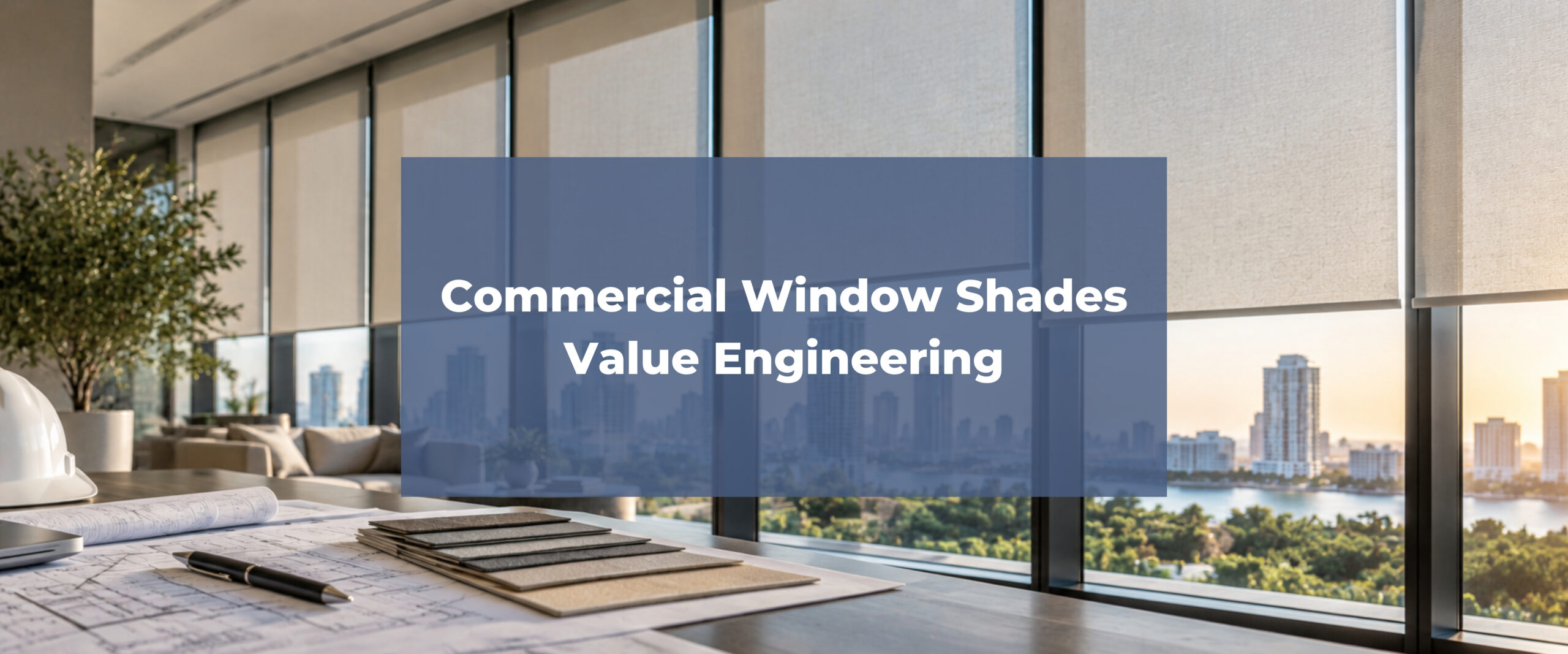


Commercial window shade value engineering is the process of reviewing a specified window treatment package to improve cost, lead time, or project execution while preserving the performance and requirements that matter to the project.
If your commercial window treatment package is already specified with Mecho, Hunter Douglas, SWFcontract, or another commercial manufacturer, but the cost, lead time, or product configuration no longer works for the project, ShadeMonster can be considered as a value-engineered alternative where the specification allows for an alternate or approved equal.
But our approach to value engineering isn’t simply to quote a less expensive shade.
ShadeMonster manufactures commercial window treatments in the U.S. and works directly with developers, general contractors, architects, and project teams. Because we control manufacturing and support the project from product selection and estimating through production, coordination, delivery, installation, and future replacement, we can look for value across the entire window treatment package — not only in the price of the product.
We look for unnecessary cost, not necessary performance.
Commercial window treatment specifications are often developed well before a project reaches procurement. By the time pricing is finalized and construction is moving forward, budgets, schedules, product availability, and even some project requirements may have changed. This is often the point when value engineering becomes part of the conversation.
When a project has been designed around Mecho, Hunter Douglas Architectural, SWFcontract, or another commercial system, the starting point shouldn’t be finding the closest product at a lower price. It should be understanding what the specified system was selected to accomplish.
A commercial window shade VE review may evaluate:
When the project documents allow an alternate manufacturer or approved equal, ShadeMonster can review those requirements and determine whether a different product or configuration can deliver the required performance while improving cost, lead time, or overall project execution.
Sometimes the opportunity is obvious. Other times, several relatively small changes across the package create the value. And sometimes the review confirms that part of the original specification shouldn’t be changed at all.
That’s the difference between value engineering and simply cutting cost.
ShadeMonster commercial systems are designed to create value without losing sight of performance, consistency, or long-term use.
Standardized for Scale
Repeatable systems create consistency across large multifamily, hospitality, student housing, and mixed-use projects.
Streamlined for Value
Focused configurations help simplify specifications, improve production efficiency, and control project costs.
ShadeMonster manufactures its commercial window treatments in-house in the U.S., supporting both custom made-to-order production and high-volume standardized programs.
For value engineering, that matters because we’re not limited to choosing a less expensive finished product from a catalog. We can look at how the package itself is built.
Could another fabric provide the required performance? Does every opening need the same hardware configuration? Is fascia necessary throughout the building? Could the motorization strategy be simplified? Is a particular component creating unnecessary cost or lead time?
Because we control manufacturing, we can look for value across the entire window treatment package—not only in the price of the product. Our support extends from product selection and estimating through production, coordination, delivery, installation, and future replacement.
Factory-direct, in this context, isn’t simply about price. It gives us more places to look for value before compromising something the project actually needs.
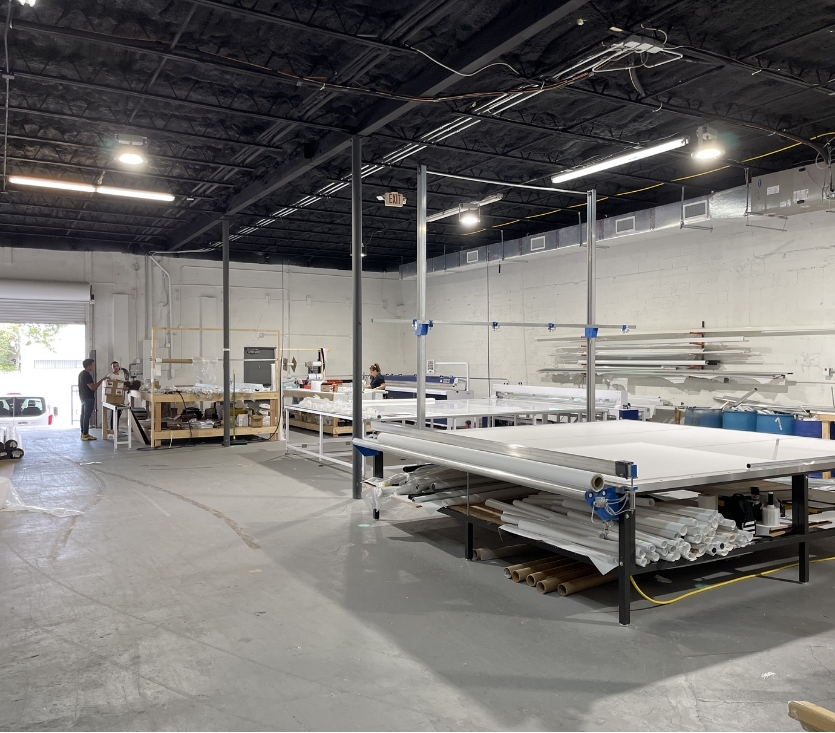
The economics of VE become particularly meaningful as project quantities increase.
A $10 difference on one shade is $10. Across 1,000 shades, it’s $10,000. The same principle applies to fabric, fascia, hardware, motors, packaging, freight, and installation.
This is why value engineering a large window treatment package often isn’t about one dramatic substitution. It’s about making the right decisions repeatedly across the project.
One of the most important decisions is determining what should be standardized and what actually needs to remain custom.
On multifamily and other repeat-opening projects, standardizing fabrics, finishes, hardware, and typical configurations can improve production consistency, simplify installation, and make future replacements easier. But oversized windows, amenity spaces, multi-panel openings, and unusual mounting conditions may still require a different approach.
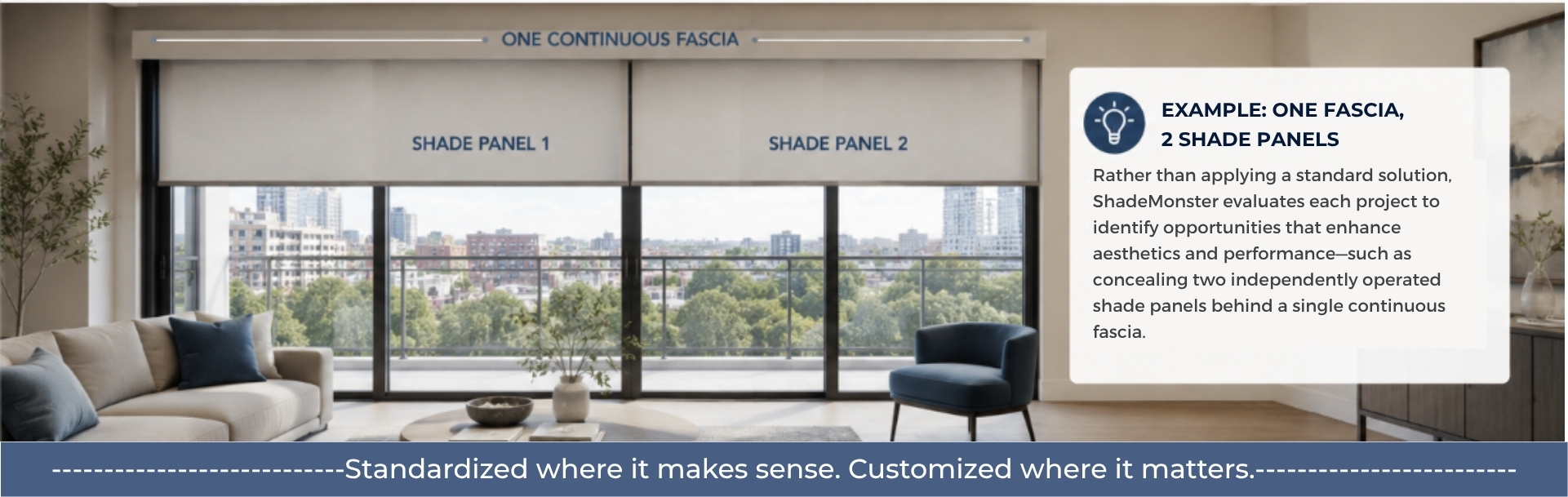
For example, a wide opening requiring two independently operated shade panels can, where appropriate, be concealed behind one continuous fascia—solving the unusual condition without turning the entire project into a custom program.
As project quantities increase, consistency becomes just as important as cost. A small issue with hardware, dimensions, finishes, or installation may be insignificant on one opening; repeated across 500 openings, it becomes a project problem.
That is why a successful VE solution has to be repeatable as well as economical. Standardized configurations, controlled production, and clear project specifications help ensure that what is approved for the first units can be reproduced consistently throughout the building.
For large commercial projects, the goal isn’t simply to save on each shade. It’s to create meaningful value while maintaining consistency across hundreds or thousands of openings.
The lowest shade price isn’t necessarily the lowest project cost. A meaningful VE review should consider not only what the shade costs, but how the system affects installation, coordination, schedule, and long-term building operations.
Motorization is a good example. The cost of a motorized shade system extends beyond the motor itself to power requirements, wiring, controls, integration, accessibility, and installation. A lower-priced motor doesn’t necessarily result in a lower-cost system.
ShadeMonster supports battery and hardwired motorized window shades, including Somfy and ShadeMonster motor options and smart automation applications. This allows the motorization strategy to be evaluated around the application and project requirements rather than assuming every opening needs the same solution.
The same principle applies to schedule, logistics, and installation. A product that costs less but can’t meet the construction schedule, creates complicated freight requirements, or adds installation labor may not represent better value.
ShadeMonster supports nationwide direct-to-site or warehouse delivery, centralized ordering, and coordinated freight for commercial programs—so those factors can be considered as part of the VE review rather than after the product has already been selected.
On multifamily and portfolio projects, individual shades and components will eventually need replacement. ShadeMonster’s digital system maintains product specifications and order information to support repeat orders and exact replacements while preserving consistency in materials, sizes, and finishes.
That means the VE conversation isn’t only “What does this cost today?” It can also include “How easy will this system be to manage five years from now?”
At ShadeMonster, that is ultimately how we approach commercial window shade value engineering: looking at the package as a whole—from product and motorization to installation, logistics, and long-term serviceability. The goal is not simply to spend less, but to make sure the project is spending where it matters.
If cost, lead time, or complexity is putting pressure on your window treatment package, let us take another look. We’ll review the specification and show you where a ShadeMonster VE solution can create value without losing sight of the project requirements.
Get in Touch NowRequest SamplesWhat is value engineering for commercial window shades?
Value engineering reviews a commercial window treatment specification to identify opportunities to improve cost, lead time, or project execution while maintaining the performance and requirements that matter. This can include evaluating fabrics, hardware, fascia, motorization, manufacturing, installation, and logistics.
Can ShadeMonster be used as an alternative to Mecho, Hunter Douglas, or SWFcontract?
Yes, ShadeMonster can be proposed as a value-engineered alternative when the project specification allows alternate manufacturers or substitutions. Acceptance depends on the requirements of the individual project and the approval process established in the contract documents.
Can ShadeMonster be submitted as an approved equal?
Where a specification permits approved equals, ShadeMonster can provide product information and supporting documentation for consideration. Final approval is determined by the architect, owner, contractor, consultant, or other party designated in the project documents.
Does value engineering mean using a lower-quality shade?
It shouldn’t. The purpose of VE is to identify where value can be created without compromising requirements that are important to the project. ShadeMonster reviews the specification to determine what should remain and where an alternative product, configuration, or approach may make sense.
When should a commercial window treatment package be reviewed for value engineering?
Ideally, before procurement is finalized. An early review gives the project team more flexibility to evaluate product alternatives, lead times, motorization, installation requirements, and potential cost efficiencies before they affect the construction schedule.